For this week’s blog post, the use of unmanned systems in any capacity with regards to ethics, safety, privacy, and loss of link will be discussed. For my example, I will use the example of Williamson County and Austin Police departments deploying an unmanned aerial asset for real-world operations; specifically to help map flood zones after heavy rains and to provide intelligence, surveillance, and reconnaissance data on a suspected domestic terrorist who utilized explosives to kill civilians in Austin, Texas. Additionally, arguments and research from peer-reviewed sources will highlight the ethical, safety, and privacy concerns (in regard to federal regulations) of deploying such assets in real-world events.
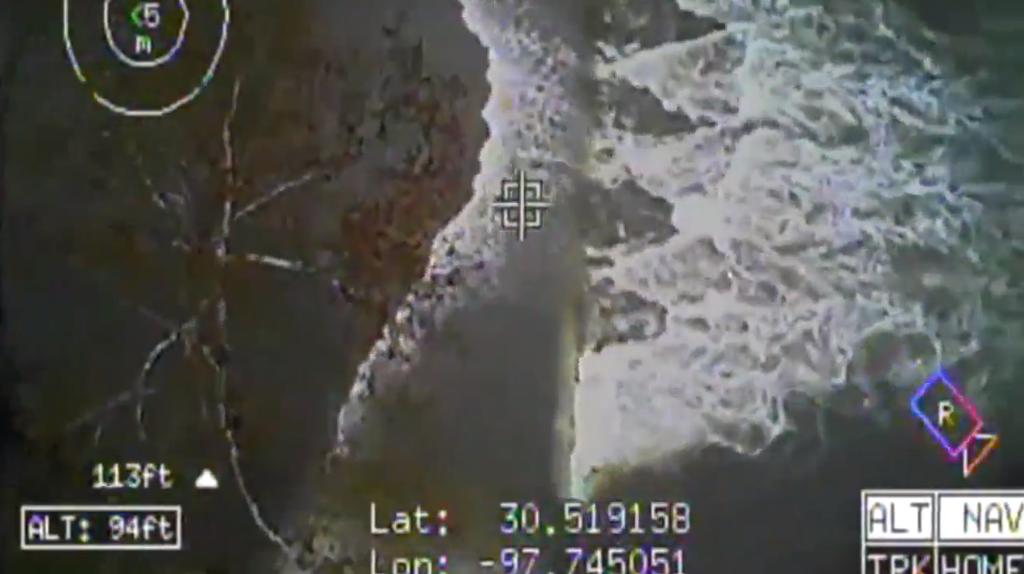
The deployment of UAS’s for dangerous situations and ISR purposes have proven fruitful. In early January 2019, massive flooding occurred around the Austin metropolitan area due to continuous rain. Rather than sending police officers to investigate low-water crossings, Williamson County Sheriff’s Department (WCSD) deployed their UAS to investigate the area. As Figure 1 depicts, the information gathered from the aerial photography and video from the UAS allowed the department to issue warnings to local residents; preventing further accidents or deaths via rapid dissemination of information.
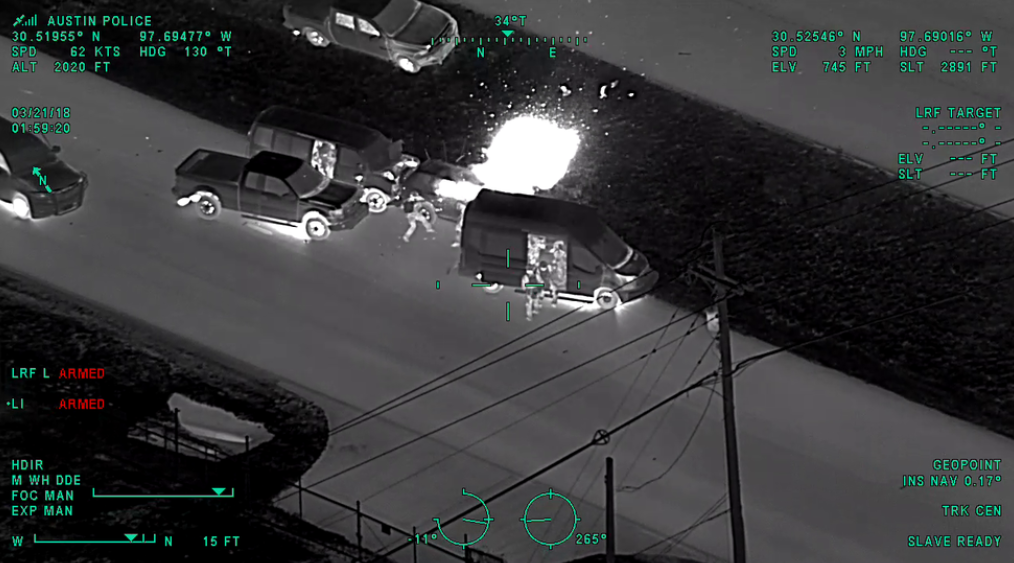
The use of this exact same UAS assisted police officers in the capture of a suspect who evaded police and fired upon law enforcement officials (Cantu, 2019). To do this, Forward-Looking Infrared (FLIR) enabled components were fitted to the UAS and upon deployment, police officers were able to locate the suspect in less than ten-minutes without incident. FLIR systems were also used in the attempted capture of Mark Anthony Conditt (Figure 2), the Austin-bomber suspected of creating 7 homemade bombs which resulted in the deaths of 3 people, including himself (CBS Austin, 2018). In each of these examples, in the event that the UAS lost linkage or control with the operator, a pre-programmed contingency option directed the platform to return to the point of origin. The rapid deployment of such systems with the capability to view in austere conditions further highlights the benefits of UAS’s used by law enforcement.
However, the integration of UAS’s within law enforcement agencies would have to overcome current FAA regulations as well as adhering to privacy concerns the public and some within state legislatures have voiced. Argued by Dow Chemical Co. v. United States, 476 U.S. 227 (Burger & Supreme Court of the United States, 1986; Bier & Feeney, 2018) aerial photography of a business without proper consent is considered invasion of privacy. Though the court of appeals reversed the decision in favor of Dow Chemicals, this is but one example of what may arise of law enforcement UAS’s conducted missions outside their scope of work.
In correlation to privacy concerns, some of the American public may view the use law enforcement UAS’s as an abuse of power. Discriminatory targeting, automated enforcement, and voyeurism have been logical arguments made victims of such issues. The latter occurred when a New York Police Department helicopter filmed a couple engaging in sexual acts and continued to record for over four minutes (Stanley & Crump, 2011). When asked, NYPD denied this filming was an infringement on people’s privacy and they were making sure nothing illegal was occurring (Dwyer, 2005; as cited in Stanley & Crump, 2011).
Within Stanley and Crump’s (2011) publication of recommendations on how to utilize unmanned aircraft for law enforcement purposes, two cases (in conjunction with Dow Chemical Co. vs. United States) ultimately brought before the United States Supreme Court acted as a catalyst that would inevitably associate themselves to future UAS uses. In the State of California vs. Ciraolo, police had received an anonymous tip that a local resident was growing marijuana in his backyard and selling it. Acting on this tip, police investigated the issue but were unable to clearly view the backyard due to high fences and brush blocking the view. As an alternative, police decided to borrow an aircraft from a local airport and use it to view the contents of the backyard to which they discovered a large amount of marijuana being grown. Ciraolo was subsequently arrested yet argued in state and federal courts “that his Fourth amendment rights were violated because the government did not get a warrant” (Stanley and Crump, p. 13). The Supreme Court ruled in favor of the State of California because “[a]ny member of the public flying in this airspace who glanced down could have seen everything that these officers observed” (Burger & Supreme Court of the United States, 1986; as cited in Stanley and Crump, 2011, p.13).
Similar in judgement, in the State of Florida vs. Riley, another tip led to the arrest of Michael Riley for the cultivation and distribution of marijuana. Riley had been growing marijuana in his greenhouse, but law enforcement was unable to view the suspected crops because of a lack of visibility. Using an aircraft, police were able to verify the presence of marijuana by looking into the greenhouse via two missing ceiling panels on the roof. Just as Ciraolo experienced, the Supreme Court ruled this was not a violation of his Fourth Amendment rights due to anyone who could have flown the same route would have seen the same thing and it was open to public view (Dwyer-Moss, 2018).
References
Bier, D. & Feeney, M. (2018). Drones on the Border: Efficacy and Privacy Implications. CATO Institute. Retrieved from https://www.cato.org/publications/immigration-research-policy-brief/drones-border-efficacy-privacy-implications
Burger, W. E. & Supreme Court of The United States. (1986). U.S. Reports: Dow Chemical Co. v. United States, 476 U.S. 227. [Periodical] Retrieved from the Library of Congress, https://www.loc.gov/item/usrep476227/.
Cantú, F. (2019). Thermal Imaging from WilCo Drone Helped Arrest Police Shooting Suspect. CBS Austin. Retrieved from https://cbsaustin.com/news/local/thermal-imaging-from-wilco-drone-helped-arrest-police-shooting-suspect
CBS Austin. (2018). APD Releases Helicopter Video of Bomber Mark Conditt’s Last Moments. CBS. Retrieved from https://cbsaustin.com/news/local/apd-releases-helicopter-video-of-bomber-mark-conditts-last-moments
Dwyer, J. (2005). Police Video Caught a Couple’s Intimate Moment on a Manhattan Rooftop. New York Times.
Dwyer-Moss,
J. (2018). The Sky Police and the Fourth Amendment. Albany Law Review. 81(3). 1047-1070. Retrieved from
http://bi.galegroup.com.ezproxy.libproxy.db.erau.edu
/essentials/article/GALE%7CA547694408?u=embry&sid=summon
Stanley, J., & Crump, C. (2011). Protecting Privacy from Aerial Surveillance: Recommendations for Government Use of Drone Aircraft. American Civil Liberties Union. 6(6). 1-22. Retrieved from https://www.aclu.org/report/protecting-privacy-aerial-surveillance-recommendations-government-use-drone-aircraft

